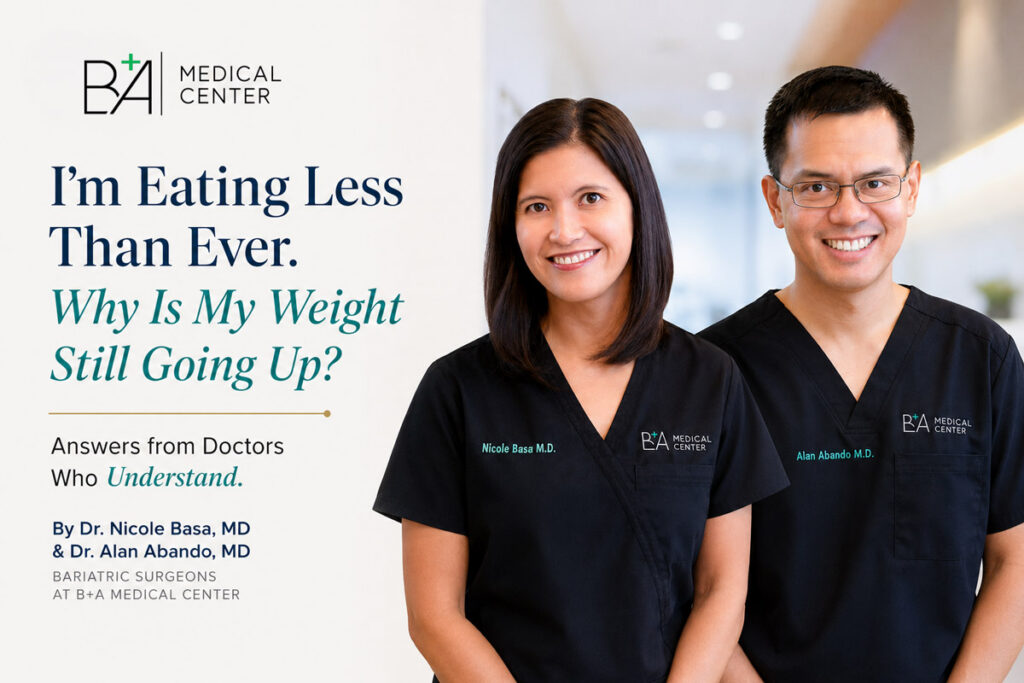
This is one of the most common — and most heartbreaking — questions we hear in our Austin practice. You are doing everything right. You are eating less, trying to move more, and the scale still won’t cooperate. We want you to know: there is almost always a medical reason behind this. And it is not your fault.
It is 11 PM. You are lying in bed running through the day in your head — the salad you had for lunch, the dinner you skipped, the walk you forced yourself to take. And somehow, you are still gaining weight. Or at the very best, staying exactly the same.
If this sounds familiar, you are not imagining it. And you are definitely not alone. At B+A Surgeons in Cedar Park and Austin, we see patients every week who have been told to “just eat less and move more” — and who are exhausted from doing exactly that with little to show for it.
The truth is that weight gain is rarely as simple as calories in versus calories out. The human body is extraordinarily complex, and when something is working against you at a metabolic or hormonal level, willpower and portion control are fighting an uphill battle. In this post, we want to walk you through the most common medical reasons people struggle to lose weight — and explain when it might be time to get a professional opinion.
The Real Reasons You May Be Gaining Weight Despite Eating Less
When you reduce calories significantly, your body interprets this as a threat. It responds by slowing your metabolism — sometimes dramatically — to conserve energy. This is called metabolic adaptation, and it is one of the most frustrating biological realities of long-term dieting.
What this means in practice: a person who has been dieting for months may burn 20–30% fewer calories at rest than someone of the same weight who has never dieted. The longer you have been restricting, the more pronounced this effect can become.
This is not a character flaw. It is your body doing exactly what millions of years of evolution designed it to do. The problem is that our bodies have not caught up to a world where food is plentiful and the “famine” we are simulating is intentional.
More pronounced with yo-yo dieting
Very common in our patients
Your body uses a complex system of hormones to regulate hunger, satiety, and fat storage. When any part of this system is disrupted, weight gain can happen even when caloric intake seems low.
Insulin resistance is particularly common and particularly misunderstood. When your cells stop responding properly to insulin, your pancreas produces more of it to compensate. High insulin levels actively promote fat storage — especially around the abdomen — and make it very difficult for your body to access stored fat for energy. You can be eating very little and still gaining weight if your insulin response is dysregulated.
Leptin resistance is equally important. Leptin is the hormone that signals to your brain that you are full. In people with leptin resistance, the brain never receives that signal clearly — leading to persistent hunger even after eating, and a constant drive to consume more than the body needs.
Ghrelin, the “hunger hormone,” also plays a role. Chronic dieting can elevate ghrelin levels, making you feel hungrier than you would be naturally — another way your body defends its weight set point.
Leptin resistance
Elevated ghrelin
Can be identified with bloodwork
Your thyroid gland controls your basal metabolic rate. When it is underactive — a condition called hypothyroidism — your metabolism slows significantly, and weight gain becomes nearly inevitable regardless of what you eat.
Hypothyroidism is remarkably common, particularly in women, and is frequently underdiagnosed. Standard TSH testing can miss subclinical hypothyroidism entirely. Many patients come to us having never had a full thyroid panel done, even after years of struggling with weight.
If you have unexplained weight gain alongside fatigue, feeling cold often, dry skin, constipation, or brain fog — thyroid function is one of the first things we want to look at.
More common in women
Often underdiagnosed
Sleep is not a luxury. It is a metabolic necessity. Chronic sleep deprivation — even at levels that feel manageable, like six hours a night — significantly disrupts the hormones that regulate appetite and fat storage.
Studies consistently show that sleep-deprived individuals have elevated ghrelin levels (more hunger), reduced leptin (less satiety signaling), higher cortisol (which promotes abdominal fat storage), and a measurable preference for high-calorie foods. You can be eating the same meals as someone who sleeps well and gaining weight faster — simply because of sleep.
Sleep apnea, which is more common in people with obesity and often undiagnosed, compounds this further by fragmenting sleep quality even when the hours seem adequate.
Raises cortisol
Sleep apnea link
Calorie counting is built on an assumption that all calories are metabolized equally and that our bodies are predictable machines. Neither is true.
The thermic effect of food — how many calories your body burns processing what you eat — varies significantly between food types. Protein requires significantly more energy to digest than fat or carbohydrates. The gut microbiome, which varies dramatically between individuals, affects how efficiently calories are extracted from food. Stress levels, meal timing, food composition, and medication use all influence how your body processes what you consume.
Beyond the science, calorie counting also tends to increase cortisol, the stress hormone that promotes fat storage — creating a particularly cruel irony where the act of obsessively tracking food can make weight loss harder.
Gut microbiome matters
Stress hormone response
Many commonly prescribed medications have weight gain as a documented side effect — one that patients are rarely warned about clearly. These include certain antidepressants (particularly SSRIs and tricyclics), corticosteroids, beta-blockers, antipsychotics, some diabetes medications, hormonal contraceptives, and antihistamines.
If you started gaining weight after beginning a new medication, that connection is worth exploring with your doctor. There are often alternatives that do not carry the same metabolic side effects.
Corticosteroids
Beta-blockers
Ask about alternatives
PCOS affects an estimated 1 in 10 women of reproductive age, and weight gain — particularly around the abdomen — is one of its hallmark features. PCOS drives insulin resistance and hormonal dysregulation that makes weight loss extraordinarily difficult through conventional means alone.
Many women with PCOS are told simply to lose weight without being given the tools to do so effectively when their hormonal environment is actively working against them. If you are a woman struggling with weight gain alongside irregular periods, skin changes, or hair loss, PCOS is worth discussing with your provider.
Drives insulin resistance
Frequently under-diagnosed
- Rapid, unexplained weight gain over a short period (weeks, not months)
- Swelling in the legs or abdomen alongside weight gain
- Extreme fatigue, cold intolerance, or hair thinning
- Increased thirst, frequent urination, or blurred vision
- Weight gain despite significantly reduced appetite
- New depression or anxiety alongside physical changes
Any of these warrant a prompt conversation with your doctor. They can indicate conditions including hypothyroidism, Cushing’s syndrome, heart or kidney issues, or undiagnosed diabetes that need medical attention beyond a weight loss program.

The “Just Eat Less” Advice Is Not Always Wrong — But It Is Often Incomplete
We want to be clear about something: caloric intake does matter. Energy balance is real. But for millions of people — particularly those dealing with insulin resistance, hormonal imbalances, chronic stress, poor sleep, or metabolic adaptation from years of dieting — the equation is far more complicated than it appears on paper.
When the standard advice of eating less and moving more has not worked for you despite genuine, sustained effort, that is not a willpower problem. That is a signal that something in your metabolic or hormonal environment needs to be addressed.
This is exactly why our program at B+A Surgeons begins with a comprehensive evaluation — not just a conversation about food and exercise, but a real look at your hormones, metabolic function, sleep, medications, and medical history. We want to understand why your body is holding onto weight before we discuss what to do about it.
What a Comprehensive Evaluation Looks Like at B+A
- Full metabolic panel and hormonal bloodwork (thyroid, insulin, cortisol)
- Medication review for weight-contributing side effects
- Sleep assessment including screening for sleep apnea
- Nutritional and dietary pattern analysis with our registered dietitian
- Discussion of surgical and non-surgical weight loss options based on your profile
- Cardiac testing and VO2 testing where appropriate
When Diet and Exercise Genuinely Are Not Enough
There comes a point and many of our patients know it well where the gap between effort and result becomes impossible to ignore. You are not eating much. You are moving as much as your body allows. And the weight is still there, or still climbing.
For patients at this stage, particularly those with a BMI above 35 or above 30 with obesity-related health conditions, bariatric surgery is not a last resort. It is, in many cases, the most evidence-based and effective intervention available.
Procedures like robotic gastric sleeve surgery and gastric bypass do not work simply by restricting food intake. They fundamentally alter the hormonal signals that drive hunger and fat storage — the same signals that have been working against you. That is why surgical weight loss often succeeds where decades of dieting have not.
Equally, for patients who are not candidates for surgery or prefer to explore other options first, our medical weight loss program — including medication-assisted weight loss, nutritional counseling, and structured lifestyle support — offers a comprehensive, medically supervised alternative.

| Approach | Best For | Addresses Hormonal Factors? | Long-Term Success Rate |
|---|---|---|---|
| Diet & Exercise Alone | Early-stage, no metabolic complications | Partially | 20–30% maintain loss at 5 years |
| Medical Weight Loss Program | Metabolic issues, medication management, pre-surgical prep | Yes — with monitoring | Better with structured support |
| Medication-Assisted (GLP-1s etc.) | Insulin resistance, moderate obesity | Yes — targets hormonal pathways | Effective while on medication |
| Bariatric Surgery (Sleeve / Bypass) | BMI 35+, or 30+ with health conditions | Yes — fundamentally resets hunger hormones | 60–80% maintain significant loss at 5+ years |
Meet Your Surgeons

Dr. Nicole Basa, MD
Dr. Basa specializes in minimally invasive and robotic bariatric surgery at BA Medical Center in Austin, Texas. Her patient-centered approach combines surgical excellence with a deep understanding of the lifestyle and professional demands her patients face. She and her team at bamedicalcenter.com provide comprehensive pre- and post-operative care designed for long-term success.

Dr. Alan Abando, MD
Dr. Abando is a board-certified surgeon known for his integrity, compassion, and technical excellence at BA Medical Center in Austin, Texas. He specializes in bariatric and minimally invasive surgery, with additional expertise in body sculpting and aesthetic treatments. His patients consistently praise his attentive care and his ability to make them feel truly supported throughout their surgical journey.
Frequently Asked Questions
Possibly, yes. Conditions including hypothyroidism, insulin resistance, PCOS, Cushing’s syndrome, and certain medication side effects can all cause weight gain independent of caloric intake. A comprehensive metabolic evaluation is the right starting point — not another diet.
Yes. Elevated cortisol — the primary stress hormone — directly promotes fat storage, particularly in the abdominal area. It also disrupts sleep, increases appetite for high-calorie foods, and impairs insulin sensitivity. Chronic stress is a genuine metabolic driver of weight gain.
Generally, bariatric surgery is considered for patients with a BMI of 35 or higher, or a BMI of 30 or higher with obesity-related health conditions such as Type 2 diabetes, sleep apnea, or high blood pressure. The best way to find out is a consultation with our team — we evaluate each patient individually and discuss all available options, not just surgery.
Our comprehensive program includes metabolic and hormonal evaluation, nutritional counseling with a registered dietitian, cardiac and VO2 testing, medication-assisted weight loss options, support groups, and long-term follow-up care. We work with patients at every stage, before, during, and well after their weight loss journey.
Modern bariatric surgery, particularly when performed robotically using the da Vinci Surgical System as we do at B+A, carries a very low risk profile — comparable to a gallbladder removal for most patients. The risks of untreated obesity, including cardiovascular disease, diabetes, sleep apnea, and joint disease, typically far exceed the surgical risk for appropriate candidates. We discuss all of this in detail during your consultation.
What We Want Patients to Know
If you’re struggling with your weight despite eating less, you’re not failing.
Weight is influenced by hormones, metabolism, sleep, stress, medical conditions, medications, and many other factors that have little to do with willpower alone.
Over the years, we’ve helped thousands of patients who felt frustrated, discouraged, and stuck. Many were surprised to learn there were underlying medical reasons behind their struggles and effective treatment options available.
The most important thing we want you to remember is this: you don’t have to figure it out alone.
If you’ve been doing everything you can and still aren’t seeing the results you expect, it may be time to look beyond calories and explore what’s really standing in your way.
If This Sounds Familiar, There May Be More Going On Than Calories Alone
At B+A Surgeons in Cedar Park and Austin, we help patients identify the underlying factors contributing to weight gain and develop a personalized treatment plan — whether that means medical weight loss, surgical intervention, or both. You deserve real answers, not another diet to try.
Schedule a Consultation
Learn About Our Program