There is no single “best” bariatric surgery, only the one that is best for your unique life. The right choice depends on your health history, goals, and daily habits. As a husband-and-wife team, we take the time to sit down with you and figure this out together, ensuring you feel like family, not just a patient.
If you have been researching weight loss surgery, you have likely come across terms like gastric sleeve, gastric bypass, or duodenal switch. It is completely normal to feel overwhelmed by the options and wonder which one actually applies to your situation.
At BA Medical Center in Austin, Dr. Nicole Basa and Dr. Alan Abando perform all of these procedures. Because we work side-by-side as surgeons and partners, we bring a unique level of collaboration to your care. We have helped hundreds of patients in Central Texas navigate this decision, and we wrote this guide to help you start that same journey with confidence.
This post is their answer to all of them at once. Or if you’d rather hear it directly from Dr. Basa first, watch this short overview of what to expect from your consultation:
Watch · B+A Surgeons Consultation Overview
Dr. Nicole Basa walks through what happens during a weight loss surgery consultation from discussing your medical history to building a personalized procedure plan.
The Four Main Bariatric Procedures
Here is our honest, practical breakdown of what each surgery entails, who typically sees the most success with them, and the trade-offs you should consider.
What happens: We remove about 80% of the stomach, leaving a narrow, banana-shaped pouch. This procedure does not involve any rerouting of your intestines.
How it works: It uses restriction (you feel full with much less food) and reduces “ghrelin,” the hormone responsible for hunger. Many of our patients find they simply don’t have the same “food noise” or constant hunger after this procedure.
Best suited for: Patients with a BMI of 35 to 50 who want a straightforward surgical approach with powerful results. It is also an excellent “first-stage” option for patients with very high BMIs.
No intestinal rerouting
Reduces hunger hormones
What happens: We create a small stomach pouch about the size of an egg and connect it directly to the small intestine. This “bypasses” the rest of the stomach and the first part of the intestine.
How it works: This provides both restriction and “malabsorption,” meaning your body absorbs fewer calories. It also triggers significant hormonal changes that can often put Type 2 diabetes into remission almost immediately.
Best suited for: Patients struggling with severe acid reflux (GERD), Type 2 diabetes, or those with higher BMIs who need the strongest metabolic intervention possible.
High diabetes remission
Strongest metabolic results
What happens: We place a soft silicone band around the top of the stomach to slow down how fast you can eat. It is connected to a small port under the skin so we can adjust the tightness over time.
How it works: Purely through restriction. It makes you feel full faster by slowing the passage of food.
Best suited for: While this procedure has declined in popularity compared to the sleeve, it remains an option for patients who strongly prefer a fully reversible surgery and are committed to frequent office visits for adjustments.
Lowest initial surgical risk
What happens: This is a two-part procedure. We perform a sleeve gastrectomy first, then reroute a large portion of the small intestine. This results in the most significant reduction in calorie and fat absorption.
How it works: It combines the hunger reduction of the sleeve with aggressive malabsorption. It is the most powerful tool we have for weight loss.
Best suited for: Patients with a BMI over 50 or severe metabolic syndrome. Because this requires very strict lifelong vitamin intake, we evaluate our DS candidates very carefully to ensure long-term safety.
Strongest intervention
Side-by-Side Comparison
Every body is different, but this table provides a general idea of what to expect. We will discuss your specific health markers in detail during your one-on-one consultation.
| Factor | Gastric Sleeve | Gastric Bypass | Adj. Band | Duodenal Switch |
|---|---|---|---|---|
| Avg. excess weight loss | 60–70% | 65–80% | 40–55% | 70–90% |
| Surgical complexity | Moderate | Moderate–High | Low | High |
| Reversible? | No | Rarely | Yes | No |
| GERD / acid reflux | May worsen | Often improves | Neutral | Variable |
| Type 2 diabetes | Strong improvement | Excellent remission | Modest | Highest remission |
How Dr. Basa and Dr. Abando Help You Decide
There’s no algorithm that spits out the right answer. The decision involves a real conversation — about your health history, your relationship with food, your goals, your support system, and what you’re realistically prepared for on the other side of surgery.
At your consultation, Dr. Basa and Dr. Abando will review:
- Your current BMI and body composition
- Metabolic conditions especially Type 2 diabetes, hypertension, and sleep apnea
- History of GERD or esophageal issues
- Prior abdominal surgeries
- Eating patterns and any history of binge eating
- Your understanding of the lifestyle changes required post-surgery
- Your support system at home
They will also walk you through the insurance pre-authorization process if applicable including what documentation is typically required and what to expect in terms of timeline.
A note from the practice: One thing that sets BA Medical Center apart is that you have two experienced bariatric surgeons involved in your care not just one. Dr. Basa and Dr. Abando consult together on complex cases, and patients often find there’s a level of thoroughness and warmth that comes from working with a team who genuinely shares a commitment to this work.
Meet Your Surgeons

Dr. Nicole Basa, MD
Dr. Basa specializes in minimally invasive and robotic bariatric surgery at BA Medical Center in Austin, Texas. Her patient-centered approach combines surgical excellence with a deep understanding of the lifestyle and professional demands her patients face. She and her team at bamedicalcenter.com provide comprehensive pre- and post-operative care designed for long-term success.

Dr. Alan Abando, MD
Dr. Abando is a board-certified surgeon known for his integrity, compassion, and technical excellence at BA Medical Center in Austin, Texas. He specializes in bariatric and minimally invasive surgery, with additional expertise in body sculpting and aesthetic treatments. His patients consistently praise his attentive care and his ability to make them feel truly supported throughout their surgical journey.
Frequently Asked Questions
Many insurance plans do cover these procedures, but the requirements vary significantly between providers. Most companies require documentation of a BMI over 40, or a BMI over 35 if you have at least one health issue like Type 2 diabetes or sleep apnea. They also typically look for a history of a medically supervised weight loss program. Our team at BA Medical Center is very experienced in this area and can help you navigate the pre-authorization process to understand exactly what your plan requires.
Sleeve revision to a gastric bypass is actually one of the most common revision procedures we perform. Please know that this is a real medical option and is never a “sign of failure.” Every metabolism is unique, and some patients simply respond better to the bypass mechanism. We evaluate all revision candidates very thoughtfully to ensure a second procedure is the right move for your long-term health.
Every bariatric procedure follows a phased diet progression. You will typically start with clear liquids and slowly move to pureed foods, then soft foods, before returning to a modified regular diet over about 6 to 8 weeks. It is important to remember that “normal” eating will look different after surgery. You will prioritize protein, eat much smaller portions, and learn to eat more slowly to support your new digestive system.
Not necessarily. Many of our patients travel to Austin from out of state and from throughout the US specifically for our care. They then establish a relationship with a local provider back home for their regular follow-up visits. If you are coming from out of town, we can discuss exactly how that coordination works during your initial consultation.
The bottom line
Choosing the right bariatric procedure is one of the most personal decisions you will ever make, and there is no algorithm that can give you the perfect answer.
We know that the research process can feel overwhelming. Our goal with this guide was to provide you with a clear, honest starting point—not to push you toward one specific procedure, but to help you walk into your consultation already knowing the right questions to ask.
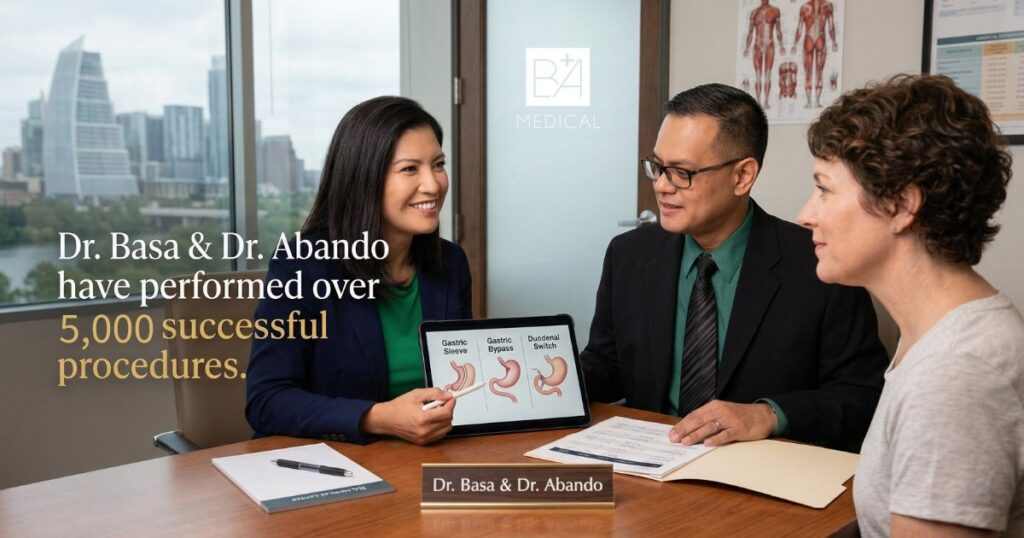
With over 5,000 successful procedures between us, we, Dr. Basa and Dr. Abando, have helped hundreds of patients in the Austin area navigate this exact decision. From your very first consultation through your long-term follow-up care, you are truly a part of the BA Medical Center family .
Ready to take the next step?
Schedule a personalized consultation with us at BA Medical Center. We’ll take the time to answer every question you have.