

If you lost weight on a GLP-1 medication and the weight is now coming back, you are not doing anything wrong. This happens to a significant number of patients, and there is a clear biological explanation for it. This post will walk you through what is actually happening and what your options are.
You did everything right. You got the prescription, adjusted to the injections, and the scale finally started moving in the right direction. For a while, it worked.
Now the weight is creeping back. Maybe the medication feels less effective than it did. Maybe you had to stop because of cost, side effects, or supply issues. Maybe you are still taking it and the results have slowed to a standstill.
Whatever the specific situation, the feeling is the same: frustrated, confused, and wondering what happened.
At B+A Surgeons in Cedar Park and Austin, we see this regularly. The first thing we want to say is: this is not a personal failure. The biology here is real and worth understanding before you decide what to do next.
What GLP-1 Medications Actually Do
GLP-1 medications work by mimicking a hormone your body produces naturally after eating. They slow digestion, reduce appetite signals in the brain, and help regulate blood sugar. For many patients, they produce meaningful weight loss, sometimes significant weight loss.
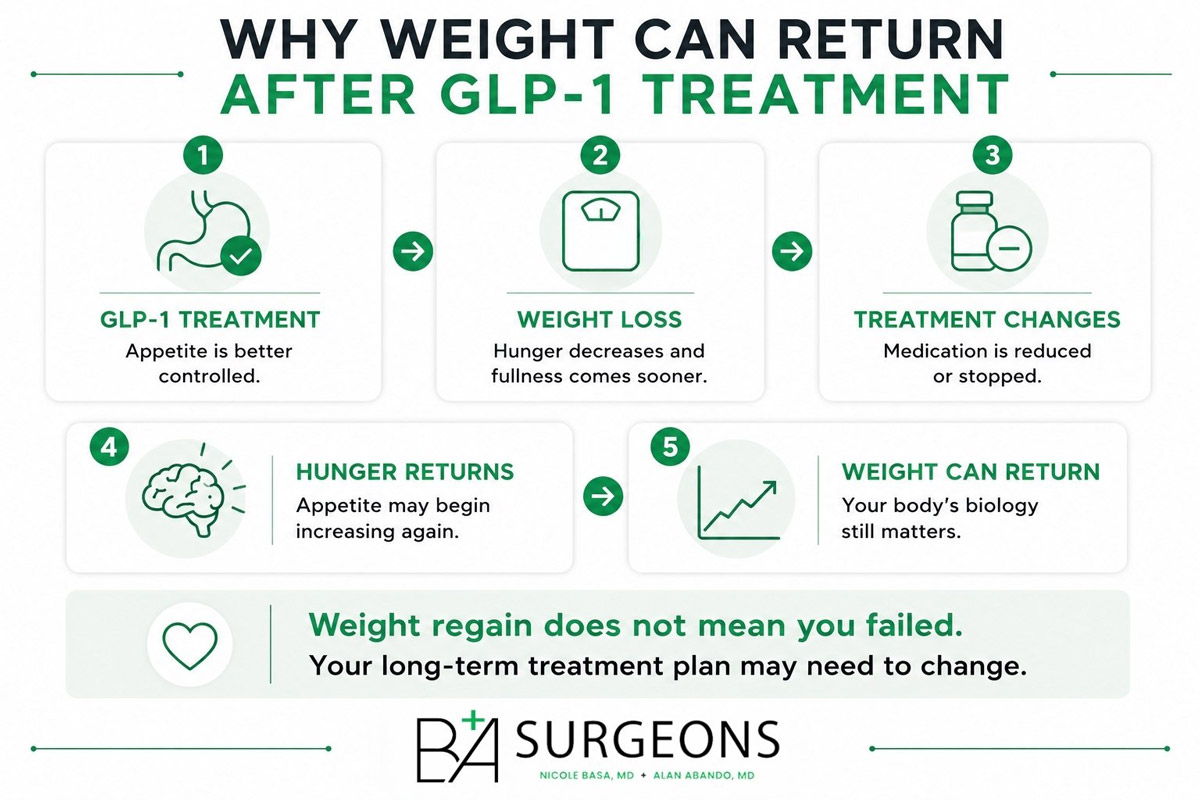
But they do not change your underlying biology. Your body’s weight set point, your hunger hormone baseline, your metabolic rate these are not permanently reset by the medication. They are managed while you take it. When the medication stops or its effectiveness fades, the underlying biology reasserts itself. Understanding that distinction is the key to understanding what you are experiencing now.
Why the Weight Is Coming Back
Your body has a defended weight range that it works to maintain. Think of it as a thermostat. GLP-1 medications suppress the signals that push you back toward that range. They do not move the setting itself.
When the medication is stopped or reduced, those signals come back. Your body begins working to recover the weight it lost, the same way it would after any period of restricted intake. This is not failure. It is your body doing exactly what it was designed to do.
Biological defense
Expected response to stopping
GLP-1 medications reduce ghrelin, the hormone that drives hunger, and enhance satiety signaling. While you are taking the medication, you feel less hungry and fuller with less food. That is largely what produces the weight loss.
When the medication leaves your system, ghrelin rises again. Appetite returns, often stronger than it felt during treatment, because your body has been in a state of hormonal suppression. Most patients are not warned about this. It catches them off guard and gets misread as a loss of willpower, when it is actually a predictable hormonal rebound.
Appetite returns
Often misread as willpower failure
Weight loss, however it is achieved, triggers metabolic adaptation. Your body responds to losing weight by slowing its resting metabolic rate and becoming more efficient at conserving energy. This happens with GLP-1 medications just as it does with caloric restriction.
The result is a difficult gap. When you stop the medication, your appetite returns to its previous level, but your metabolism is now running more slowly than it was before you started. You are eating more than your adapted metabolism can keep up with, and the weight accumulates faster than it came off.
Energy conservation
Well-documented in research
This is worth saying plainly. GLP-1 medications are not a course of treatment with a defined endpoint, like antibiotics. They are designed to be used long term. The research that established their effectiveness was largely conducted on patients who remained on the medication throughout the study period.
The weight regain data comes from studies where patients stopped. Stopping without a plan, whether because of cost, access, side effects, or a mistaken belief that the work was done, is where things go wrong for most patients. The medication was doing more heavy lifting than many patients realize until it is no longer there.
Regain expected after stopping
A plan matters before stopping
This Is Biology, Not Willpower
Weight regain after stopping a GLP-1 medication is not evidence that you lack discipline or failed to make the right lifestyle changes. Clinical studies consistently show that patients who do everything correctly — diet, exercise, behavioral support — still regain a significant portion of their lost weight after stopping. The medication was managing biological processes that do not simply stay managed once it is gone.
What the Research Tells Us
The clinical data on this is consistent and worth knowing. In one widely cited trial, participants who stopped semaglutide after 68 weeks of treatment regained an average of two thirds of their lost weight within a single year, despite continuing lifestyle intervention throughout that period.
Similar patterns have been observed across other GLP-1 medications. Stopping the medication is not a neutral event. It sets a specific biological process in motion, and without a clear plan for what comes next, most patients end up back near where they started.
This does not mean GLP-1 medications are not worth using. For many patients, they are a meaningful and appropriate tool. It means that the decision to start, continue, or stop them deserves a serious conversation with a medical team that understands the full picture, not just the prescription.
Signs the Medication May Be Losing Its Effectiveness
- Weight loss has plateaued for more than 8 to 12 weeks despite staying consistent with the medication
- Appetite is returning to previous levels at the same dose
- You are struggling to maintain access due to cost, supply, or insurance changes
- You have regained weight after a period of successful reduction
- Side effects are making it hard to stay on the medication consistently
- The blood sugar benefits you saw initially have diminished
Any of these are worth bringing to your medical team. They are not signs of failure. They are signals that the current approach may need to be reassessed.
What to Do If the Weight Is Coming Back
The worst response is to assume the problem is eating less and try harder. The second worst is to do nothing and wait. Here is what we typically recommend when a patient comes to us in this situation:
When Bariatric Surgery Is Worth a Serious Conversation

Surgery deserves a real look when one or more of these is true:
- GLP-1 medications produced meaningful weight loss, but regain is happening after stopping or reducing
- The medication is no longer affordable or consistently accessible
- Weight loss from medication has plateaued well below your goal
- You have obesity-related health conditions — type 2 diabetes, sleep apnea, high blood pressure, joint disease — that need a more durable solution
- You have tried multiple non-surgical approaches over time without lasting results
We have a full breakdown of how GLP-1 medications and bariatric surgery compare — including results, insurance coverage, out-of-pocket costs, and who tends to do best with each approach — in our post GLP-1 Medications vs. Bariatric Surgery: Which Is Right for You?
Surgery After Trying GLP-1 Medication Is Not Failure
We hear this concern often, and we want to address it directly. Patients come in feeling like needing surgery after trying medication means they did not try hard enough. It does not.
GLP-1 medications are a tool. Bariatric surgery is a different tool. Neither one is a moral statement about the person using it. Surgery changes the structural and hormonal environment of your digestive system in a way that no medication can replicate. For patients who need that level of intervention, it is simply the right tool for the situation.
Many of our surgical patients previously used GLP-1 medications. Some found that surgery gave them the durable foundation the medication could not sustain. Others used medication before surgery specifically to reduce operative risk and improve outcomes. That is a legitimate and increasingly common care pathway, not a backup plan.
A Note on Using GLP-1 Medications Before Surgery
For some patients, GLP-1 medications serve an important role before bariatric surgery. Reducing weight ahead of the procedure can lower surgical risk and improve recovery. If you have been on a GLP-1 medication and are now considering surgery, your prior treatment is not a detour. It may have been preparation.
How Dr. Basa and Dr. Abando Approach This
When a patient comes to us after a GLP-1 experience that has not gone the way they hoped, we start by listening.
We want to know what the medication did for you, what it did not do, why you stopped or reduced it, and what has happened since. We look at the full picture — your weight history, your current health conditions, your metabolic function, and what you can realistically maintain long term.
From there we have an honest conversation about what makes sense next. Sometimes that is restarting or adjusting medication under closer supervision. Sometimes it is a structured medical weight loss program with more support built in. And sometimes surgery is the clearest path forward.
We are not here to move you toward any particular outcome. We are here to help you figure out what is actually going to work for your situation.
Meet Your Surgeons

Dr. Nicole Basa, MD
Dr. Basa specializes in minimally invasive and robotic bariatric surgery at BA Medical Center in Austin, Texas. Her patient-centered approach combines surgical excellence with a deep understanding of the lifestyle and professional demands her patients face. She and her team at bamedicalcenter.com provide comprehensive pre- and post-operative care designed for long-term success.

Dr. Alan Abando, MD
Dr. Abando is a board-certified surgeon known for his integrity, compassion, and technical excellence at BA Medical Center in Austin, Texas. He specializes in bariatric and minimally invasive surgery, with additional expertise in body sculpting and aesthetic treatments. His patients consistently praise his attentive care and his ability to make them feel truly supported throughout their surgical journey.
Frequently Asked Questions
Yes, and it is more common than most patients expect. Clinical studies consistently show significant weight regain within 12 months of stopping, even when patients continue lifestyle changes. This is a known biological response to stopping the medication, not a sign that something went wrong with your treatment or your effort.
Research suggests that many patients regain roughly half to two thirds of their lost weight within a year of stopping. The amount varies based on how long they were on the medication, the dose, the specific medication, and what support they have in place after stopping. Regain tends to be faster than the original weight loss was.
In many cases, yes. Restarting the medication is an option worth discussing with your prescriber, particularly if cost or supply was the reason you stopped rather than a medical one. The bigger question is whether restarting makes sense as a long-term plan, or whether this is a good point to evaluate other options as well.
This is one of the most common situations we see. If cost or access is making long-term use unsustainable, that is a clinically relevant factor, not a personal problem to manage around. It belongs in the conversation about what to do next, including whether surgery makes sense for your situation.
Yes. Prior use of GLP-1 medications does not reduce the effectiveness of bariatric surgery. In many cases it is a positive factor, because patients who have already made lifestyle changes around eating and activity tend to do well after surgery. Your surgical team will review your full history before making any recommendation, but prior GLP-1 use is not a barrier.
Yes to both. Some patients use GLP-1 medications before surgery to reduce weight and lower operative risk. Others use them after surgery to manage weight plateau or regain during recovery. We discuss this on a case-by-case basis based on where you are in your treatment and what your goals are.
Generally, bariatric surgery is considered for patients with a BMI of 35 or higher, or a BMI of 30 or higher with obesity-related health conditions such as type 2 diabetes, sleep apnea, or high blood pressure. Insurance requirements vary by plan. The most useful step is a consultation with our team, where we look at your full picture and discuss all available options.
Both improve type 2 diabetes, but surgery tends to produce more dramatic and durable results. Gastric bypass in particular has shown high rates of remission, sometimes within days of the procedure and before significant weight loss has occurred. GLP-1 medications also improve blood sugar control and are FDA-approved for diabetes management. For patients with advanced or long-standing diabetes, surgery often offers the stronger metabolic outcome. We look at this individually for each patient.
What We Want You to Take Away From This
GLP-1 medications work for many patients. They can also stop working, become unaffordable, prove insufficient for what the patient actually needs, or produce regain after stopping. None of those outcomes mean you failed.
Weight regain after stopping these medications is expected, well-documented, and driven by biology. The right response is not to blame yourself or try harder at something that is not working. The right response is to reassess with a team that knows bariatric medicine well enough to give you an honest look at what your options actually are.
If you are in this situation, you have a real path forward. It starts with the right conversation.
Not Sure What to Do Next?
At B+A Surgeons in Cedar Park and Austin, we help patients who have been through the GLP-1 experience figure out what comes next. Whether that is medication, surgery, or a structured program, we will look at your full picture and give you an honest answer.
Schedule a Consultation
Learn About Our Program