
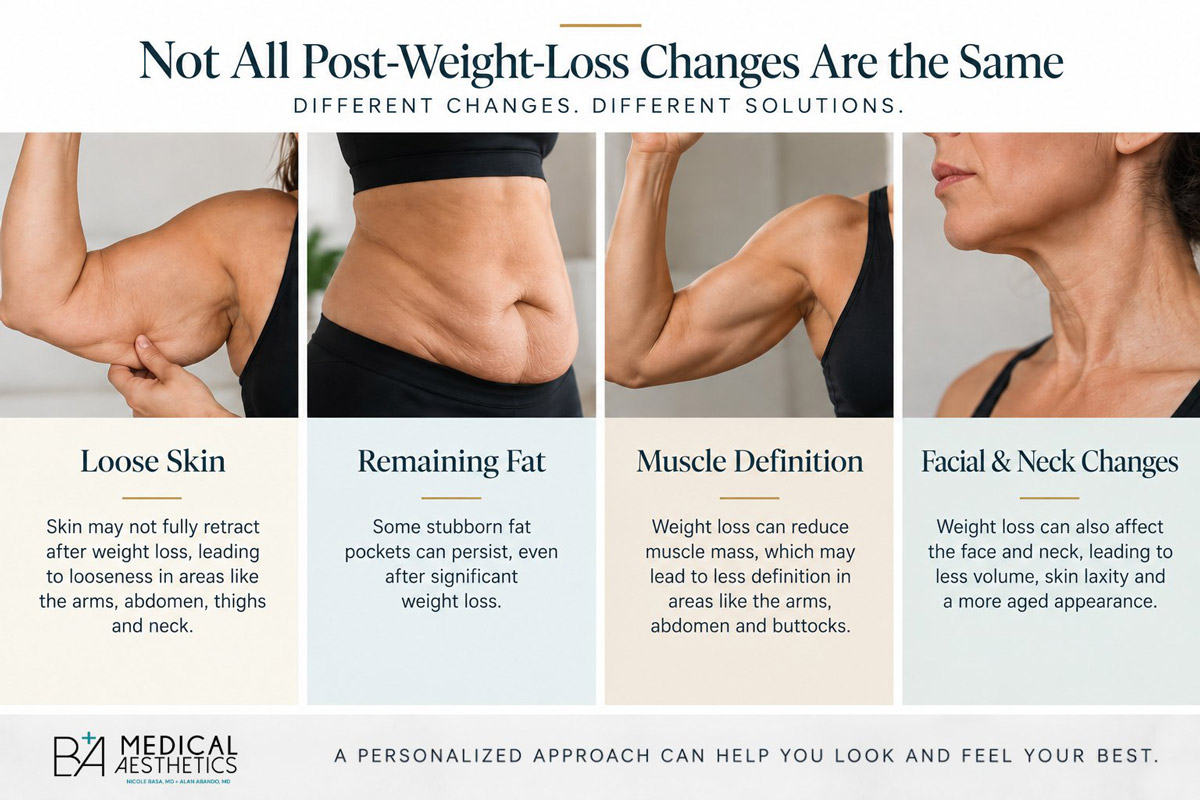
There is no single treatment for loose skin after weight loss. Mild skin laxity may respond to collagen-stimulating treatments. Loose skin with remaining pockets of fat may call for a different approach. Loss of muscle definition is another concern entirely. Facial and neck changes need to be evaluated differently from the abdomen or thighs. And when there is a significant amount of hanging excess skin, a device may simply not be enough. The first step is figuring out what tissue is actually creating the concern.
Losing a significant amount of weight can change your health, your mobility, your energy and the way you move through everyday life. But once the weight comes off, many patients notice another set of changes they were not expecting.
The abdomen may fold differently. The upper arms may feel looser. The thighs may have less volume but more laxity. Your face or neck may look different. You may be stronger and healthier than you have been in years, yet still feel that your body has not completely caught up with the weight you lost.
We see this often at B+A Medical Center in Cedar Park, serving the greater Austin area, particularly among patients who have experienced substantial weight loss through bariatric surgery, GLP-1 medications or sustained lifestyle changes.
One of the most useful things we can tell patients is that what gets described as “loose skin” is not always just loose skin. Skin laxity, remaining fat, loss of muscle volume, changes in facial tissue and skin texture can overlap. Understanding the difference matters because those concerns are not treated the same way.
Why Does Loose Skin Happen After Significant Weight Loss?
Skin stretches as the body gains weight. When a large amount of weight is lost, the volume underneath the skin decreases, but the skin does not always contract enough to match the body’s new shape.
How much the skin rebounds varies tremendously from person to person. Age and genetics matter. So do the amount of weight lost, how long the skin was stretched, pregnancy history, smoking, sun exposure and the part of the body involved. Someone who loses the same number of pounds as another person may have a very different experience afterward.
This is also why it is difficult to predict exactly how much loose skin someone will have before significant weight loss happens. For some patients, the change is relatively mild. For others, folds of excess skin can remain around the abdomen, arms, thighs or other areas.
One Important Distinction
Weight loss can reduce the volume underneath the skin, but skin, fat and muscle do not change at exactly the same rate. What looks like one contour problem in the mirror may actually involve two or three different tissues. That is why choosing a treatment based only on a photograph or the name of a device can be misleading.
Before Choosing a Treatment, Figure Out What You Are Actually Seeing
Patients understandably come in asking whether they need “skin tightening.” During an evaluation, we are looking at something more specific: what is creating the shape you want to change?
Sometimes the main issue really is skin laxity. The skin may look softer, thinner, crepey or less firm than it did before weight loss. Depending on the area and degree of laxity, treatments that stimulate collagen or heat deeper tissue may be considered.
B+A offers several approaches along this spectrum, including Forma and Forma Plus, Define, Morpheus8, and minimally invasive options such as FaceTite or BodyTite when more correction may be appropriate.
Define
Morpheus8
FaceTite
BodyTite
Reaching a lower weight does not mean every area becomes completely lean. A patient may have lax skin over a localized pocket of fat around the abdomen, flanks, arms, thighs, jawline or neck.
That combination changes the conversation. BodyTite, for example, combines radiofrequency-assisted liposuction with tissue tightening and may be considered when localized fat and laxity occur together. FaceTite applies a similar concept to appropriate facial and neck concerns.
FaceTite
Often combined with liposuction
Significant weight loss can reveal another issue: the body may be smaller, but it may not have the muscle definition a patient expected. This is not the same thing as loose skin, and it is not solved by skin tightening alone.
This concern has become particularly common among patients who lost weight using GLP-1 medications. These medications can accelerate loss of lean muscle alongside fat, which means a patient may arrive at goal weight but look flat or undertoned rather than defined. That is a body composition issue, not a skin laxity issue, and it responds to a different set of tools.
Strength training remains important for building and preserving muscle. For selected patients, technologies such as EMSCULPT NEO or Evolve Transform may also be part of a body-contouring plan when muscle tone or body composition is part of the concern. EMSCULPT NEO delivers high-intensity electromagnetic muscle stimulation alongside radiofrequency energy, targeting muscle mass and fat simultaneously in clinically studied protocols.
Evolve Transform
Not the same as skin laxity
Especially relevant for GLP-1 patients
The face can change noticeably after substantial weight loss. Loss of facial volume can make laxity along the jawline or neck more visible. Some patients notice jowling or a softer jawline even though they are satisfied with their overall weight loss. Others find that the face looks older than expected, because the fat pads that give the face its youthful structure have changed.
Depending on the anatomy and degree of laxity, options may include Define, Forma, Morpheus8, FaceTite or MyEllevate. These treatments do different things, so the goal is not to choose the most aggressive option. It is to choose an approach that fits the actual problem.
Sometimes the patient’s biggest concern is not how much skin is present, but how that skin looks and feels. Weight changes can leave areas with crepey texture, unevenness or stretch marks that persist even after laxity improves.
Morpheus8 uses radiofrequency microneedling to stimulate collagen and elastin remodeling in the deeper layers of the skin. It may be considered when texture, stretch marks and mild laxity are part of the concern, and can be used on both the face and appropriate body areas. It should not be confused with a procedure that physically removes excess skin.
Forma / Forma Plus
Face and body areas
Does not remove excess skin
How Much Loose Skin Do You Actually Have?
The amount of laxity matters just as much as where it is. We do not think of this as a rigid grading system, but it helps to understand the general spectrum when choosing what treatment to explore.
Mild Skin Laxity
The skin may look a little softer, thinner or less firm, but there is not a large fold of excess tissue. Noninvasive treatments may make sense for the right patient, particularly when the goal is gradual improvement rather than a dramatic change.
Moderate Laxity
There may be more visible looseness, sometimes combined with localized fat or a change in contour. A minimally invasive approach may be worth discussing, because treating the skin alone may not address everything contributing to what the patient sees.
Significant Excess Skin
After very large weight loss, some patients have skin that hangs or forms substantial folds. At that point, it is especially important to set realistic expectations about what an energy-based treatment can accomplish.
Skin-tightening treatments can improve firmness and tissue quality in appropriately selected patients, but they cannot make a large amount of hanging excess skin disappear. If the amount of excess tissue is beyond what a device can reasonably improve, the right conversation may be about whether surgical removal should be considered, rather than repeatedly treating the area with nonsurgical technology.
Which Treatments May Be Considered After Weight Loss?
There is no universal “best” skin-tightening treatment after weight loss. At B+A, the choice depends on the area being treated, the amount of laxity, whether fat is also present, the patient’s goals and how much recovery they are comfortable with.
Our skin tightening overview explains the available technologies in more detail. The table below is a simpler way to understand where different options may enter the conversation. If you want a closer look specifically at BodyTite and Evolve Transform after weight loss, we covered those two in depth in the earlier article Say Goodbye to Sagging Skin After Weight Loss. This article takes the broader view because many post-weight-loss concerns involve more than skin laxity alone.
| What You’re Noticing | Options That May Be Considered | What We’re Trying to Address |
|---|---|---|
| Mild facial or neck laxity | Define, Forma, Morpheus8 | Skin firmness, collagen remodeling and texture |
| Jawline or neck laxity needing more correction | FaceTite, MyEllevate | Deeper tissue tightening and contour in selected patients |
| Mild laxity on larger body areas | Forma Plus, Evolve Transform | Noninvasive tissue remodeling and body contour |
| Loose skin plus localized fat | BodyTite | Localized fat reduction together with tissue tightening |
| Crepey texture, stretch marks or mild laxity | Morpheus8 | Skin remodeling and texture improvement |
| Loss of muscle definition or flat body composition | EMSCULPT NEO, Evolve Transform | Muscle stimulation and body contouring rather than removal of excess skin |
| Significant hanging excess skin | Individual evaluation | Determine whether device-based treatment can realistically meet the goal or whether a surgical discussion is more appropriate |
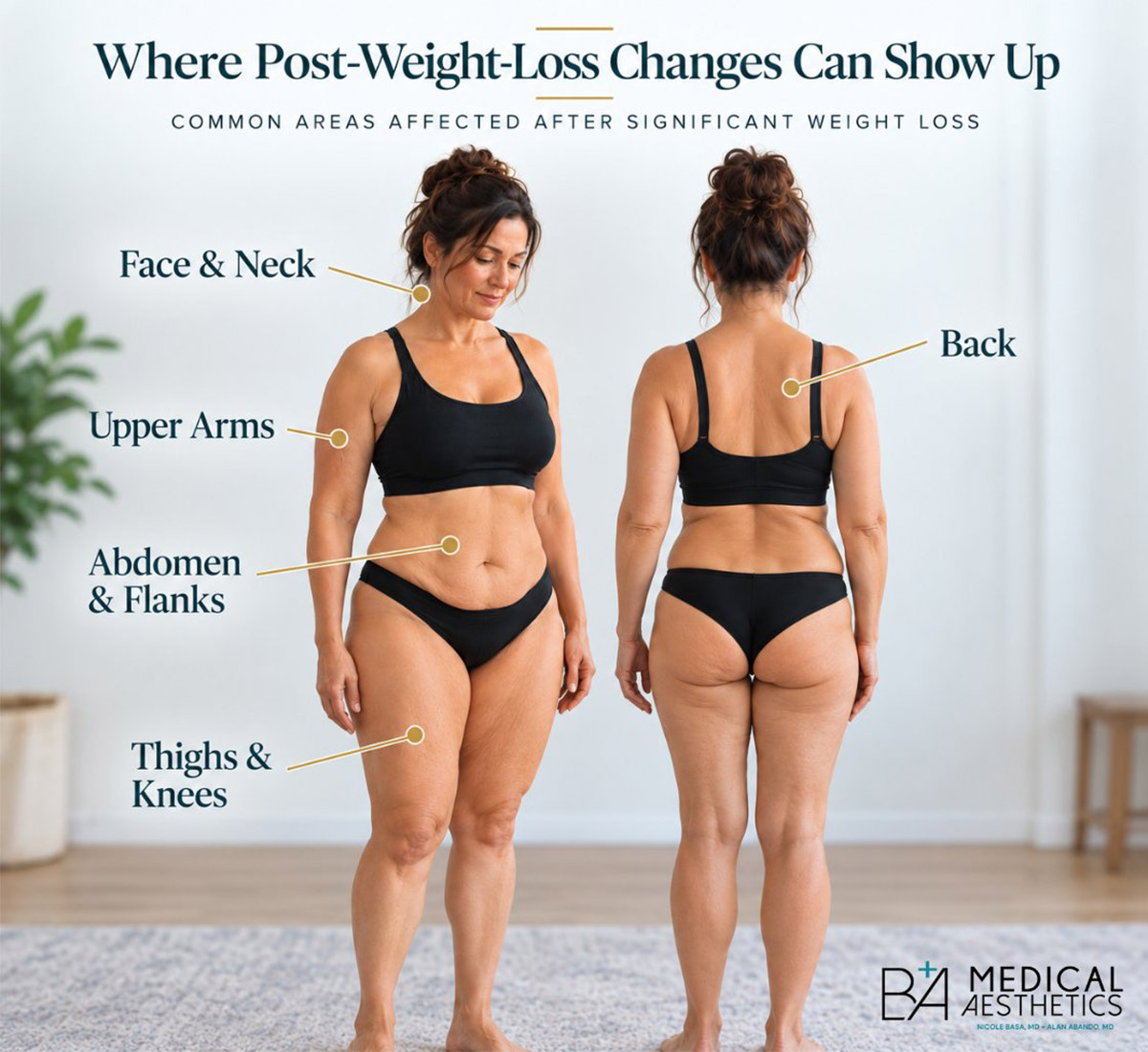
Your Face, Arms, Abdomen and Thighs Do Not All Behave the Same Way
Another reason there is no single post-weight-loss treatment is that different areas of the body have different anatomy. The same amount of weight loss can produce very different changes from one area to another.
Face & Neck
Loss of facial volume can make laxity around the cheeks, jowls, jawline and neck more noticeable. Treatment planning may focus on skin quality, deeper tissue support, localized fat or a combination of those concerns.
Upper Arms
The arms may have thin, loose skin, remaining fatty tissue or both. The amount of hanging skin is especially important when deciding whether a nonsurgical or minimally invasive approach is likely to provide meaningful change.
Abdomen & Flanks
The abdomen can involve several layers at once: loose skin, residual subcutaneous fat and changes in the abdominal wall or muscle tone. Treating only one of those may not address what the patient sees in the mirror.
Thighs & Knees
Skin laxity, texture, remaining fat and cellulite can overlap in the thighs. Around the knees, even a relatively small amount of laxity can become noticeable after substantial weight loss.
Back
The back and flanks can develop rolls or bands of lax skin after significant weight loss, particularly in patients who carried weight in the midsection. This area is often overlooked but is treatable with the same approaches used for the abdomen and flanks.
Can Exercise Tighten Loose Skin?
Exercise is extremely valuable after weight loss. Resistance training can help preserve and build muscle, improve strength and change the contour underneath the skin. It can also help patients maintain many of the health gains that came with losing weight.
What exercise cannot do is remove excess skin.
This distinction matters because a patient may look at an area and think it needs more skin tightening when what they really want is better muscle definition underneath. Or they may spend months trying to exercise away a fold of skin that exercise cannot physically remove.
For patients whose concern includes loss of muscle tone, EMSCULPT NEO or Evolve Transform may be discussed as part of a contouring plan. Those technologies are not substitutes for exercise and they do not make significant excess skin disappear.
When Should You Consider Skin Tightening After Weight Loss?
Patients often want to know exactly how long they should wait after bariatric surgery or medical weight loss before addressing loose skin. There is not one timeline that applies to everyone.
In general, the conversation becomes more useful once your weight trajectory is becoming stable and your nutrition and overall health are being appropriately managed. If your body is still changing rapidly, the area you want treated may continue to change as well, which can affect results.
For bariatric patients, this is one advantage of having a team that understands both sides of the process. Dr. Basa and Dr. Abando can look at the concern in the context of your weight-loss history, nutritional status, medical history and where you are in your recovery, rather than treating the skin as an isolated cosmetic issue.
Weight Stability Does Not Mean Perfection
You do not need to reach some imaginary ideal before asking about loose skin. The point is simply to understand whether your body is still changing enough to affect the treatment plan. If you are unsure where you are in that process, that is exactly the kind of thing we can talk through during a consultation.
The Treatment With the Least Downtime Is Not Automatically the Right Treatment
It is completely reasonable to care about downtime. Work, family, exercise and everyday life all matter when choosing a procedure. But recovery time is only one part of the decision.
A gentle noninvasive treatment may be a very good fit for someone with mild laxity who wants gradual improvement and little interruption to daily life. That same treatment may disappoint someone with considerably more loose tissue who is hoping for a significant change.
The reverse is also true. Someone with a relatively mild concern may not need a minimally invasive procedure simply because it offers greater correction.
We would rather have an honest conversation about the degree of change you want, the amount of laxity you have and what each option can reasonably accomplish. Sometimes the answer is a series of noninvasive treatments. Sometimes a minimally invasive treatment makes more sense. And sometimes the right answer is that neither approach will remove enough skin to meet the patient’s goal.
Why B+A Looks at Post-Weight-Loss Changes Differently
For Dr. Nicole Basa, aesthetics after weight loss grew naturally out of caring for bariatric patients. Patients were losing significant amounts of weight and improving their health, then returning with a new set of questions: What could they do about the loose skin? Why did their face look different? Could anything help the abdomen or arms without another major operation?
Those questions are part of why B+A Medical Center brings weight-loss care and medical aesthetics together. Dr. Basa and Dr. Alan Abando understand what happens before, during and after significant weight loss, including the fact that a patient’s goals do not end when the number on the scale changes.
Meet Your Surgeons

Dr. Nicole Basa, MD
Dr. Basa specializes in minimally invasive and robotic bariatric surgery at BA Medical Center in Austin, Texas. Her patient-centered approach combines surgical excellence with a deep understanding of the lifestyle and professional demands her patients face. She and her team at bamedicalcenter.com provide comprehensive pre- and post-operative care designed for long-term success.

Dr. Alan Abando, MD
Dr. Abando is a board-certified surgeon known for his integrity, compassion, and technical excellence at BA Medical Center in Austin, Texas. He specializes in bariatric and minimally invasive surgery, with additional expertise in body sculpting and aesthetic treatments. His patients consistently praise his attentive care and his ability to make them feel truly supported throughout their surgical journey.
Frequently Asked Questions
Some skin may gradually contract after weight loss, particularly when laxity is mild, but the amount varies widely. Age, genetics, how much weight you lost, how long the skin was stretched and the area of the body all matter. Significant hanging excess skin is unlikely to disappear simply by waiting.
There is no single best treatment for everyone. The appropriate option depends on whether you are dealing with mild skin laxity, loose skin with remaining fat, facial or neck laxity, texture changes, loss of muscle definition or significant excess skin. An evaluation helps determine which tissue is actually creating the concern before a treatment is chosen.
Mild to moderate laxity may improve with noninvasive or minimally invasive treatments that use radiofrequency, radiofrequency microneedling or related technologies. These treatments have limits. They cannot physically remove a large amount of hanging excess skin, so realistic treatment selection matters.
Exercise can build muscle and improve the shape and strength underneath your skin, but it cannot remove excess skin. For some patients, improving muscle definition makes a meaningful difference in overall body contour even though the skin itself remains. Technologies like EMSCULPT NEO can support muscle reconditioning for appropriate patients alongside a regular training program.
It can. GLP-1 medications are known to accelerate loss of lean muscle alongside fat. Patients who feel their body looks flat or undertoned at goal weight, rather than defined, may benefit from discussing muscle reconditioning as part of the plan. EMSCULPT NEO targets muscle building and fat reduction simultaneously and may be worth including in the conversation for appropriate patients. Skin laxity concerns after GLP-1 weight loss are evaluated the same way as for other post-weight-loss patients.
BodyTite is a minimally invasive treatment that may be considered when loose skin and localized fat occur together, often combined with liposuction. Evolve Transform is a noninvasive platform used for concerns that can include tissue remodeling, body contour and muscle tone. They are not interchangeable, and the appropriate choice depends on your anatomy, the amount of laxity and your goals.
Timing is individualized. In general, it is useful to evaluate post-weight-loss body changes once your weight trajectory is becoming stable and nutrition and overall health are being appropriately managed. Bariatric patients should discuss timing in the context of their postoperative progress and medical history rather than a set number of months.
You Worked Hard to Lose the Weight. The Next Step Should Be Personal Too.
There can be an odd disconnect after significant weight loss. Your health may be better. Your clothes fit differently. You may be doing things physically that were difficult before. At the same time, loose skin or other body changes can make it hard to feel completely finished with that chapter.
You do not need to treat every change that comes with weight loss. And you do not need to accept a treatment simply because it is marketed as “skin tightening.”
The useful question is much more specific: What has changed in this area, and what would actually improve it?
At B+A Medical Center, we can evaluate the skin, underlying fat, muscle tone, facial or body contour and the amount of correction you are hoping to achieve. From there, we can talk about what may help, what probably will not, and whether now is the right time to do anything at all.
Not Sure Whether It’s Loose Skin, Fat, Muscle Tone or a Combination?
Schedule a consultation with B+A Medical Center in Cedar Park, serving Austin and Central Texas. We can evaluate what changed after your weight loss and help you understand which options may realistically fit your anatomy and goals.
Schedule a Consultation
Explore Skin Tightening